Thursday, April 1, 2021

A is for Air Freight


Twice a year, as Co-ordinator of Moxons Down Under, I receive an email from The Moxon Society's membership secretary in Lancashire, England notifying me that he has posted a bulk consignment of the Moxon Magazine.  Pre-Covid, this would take 10-13 days to arrive.  However, times have changed, and I now wait three to four weeks for this package.  Sigh.  Just one of the many changes due to coronavirus.

The Magazine is eagerly awaited by our Australian membership.  The current issue, no. 67, April 2021 is a bumper edition of 40 pages in full colour.  My husband, John Bruce Moxon and I have been the Down Under Co-ordinators since 2012 when we took over from another Margaret Moxon of Brisbane.  John has to include his middle name for his role as editor of the Moxons Down Under Newsletter because he isn't the only John Moxon.  Many are members, including one more in Australia.

A is also for Adamant, the convict ship that brought Robert Moxon of Nottingham to Port Jackson in 1821.  Robert had a brother John (1821, Lord Sidmouth) - yes, another one - already in the colony.

The Adamant was one of a number of sailing ships with that name.  This one only transported convicts once.  There were 144 aboard.  It was built as a trader in 1811 and was last heard of in Timor in 1828.  Fortunately, there were no incidents on its convict contract.

Wednesday, March 17, 2021

A to Z challenge 2021 theme


Last year, I heard about the A to Z blogging challenge and decided to participate.  Bloggers are challenged to choose a theme - it certainly doesn’t have to be genealogy - and following the alphabet, upload a post on that theme every day except Sunday.  I did get as far as H, on a theme about my own ancestors.  But later, I found that successful bloggers pre-planned their posts.  So this year, I did just that, and know what I will write about each day.  I can even write ahead of the day and schedule the posts for uploading.

This year for my theme, I have chosen Moxons Down Under.

My husband John Bruce Moxon and I have been members of the English based Moxon Society since 2008, the first year we travelled overseas together in retirement. In 2012, I took over the job of volunteer webmaster until 2018 and we also administer the membership of Australians who are interested in Moxon or Moxham genealogy.  There is also a third variant here - Moxom.  The Moxon name hails from Yorkshire whilst the Moxham name was first found in Wiltshire. Inevitably, over the centuries, the names were mixed up and now, some Moxons have inherited Moxham DNA and vice versa.  Hence, the Society covers both names.

Moxons and Moxhams are now found all over the world, mostly in English speaking countries, as would be expected.

This blog covers those found in Australia and New Zealand, and occasionally in Papua New Guinea.

I’m Margaret Tucker Moxon on Facebook, and am also a member of the Society of Australian Genealogists, The  Guild of One-Name Studies (GOONS) and The Surname Society (TSS) where I am focussed on the surname Moxon.  I completed the Diploma of Family History at the University of Tasmania in 2017 and a Family History Skills & Strategies (Intermediate) Distance Learning Course with Pharos tutors in 2014. The latter covers English genealogy.

My first post for the Challenge will appear on April 1.

Saturday, December 10, 2016

Fleeing to the Blue Mountains: Viv and Bert Moxon

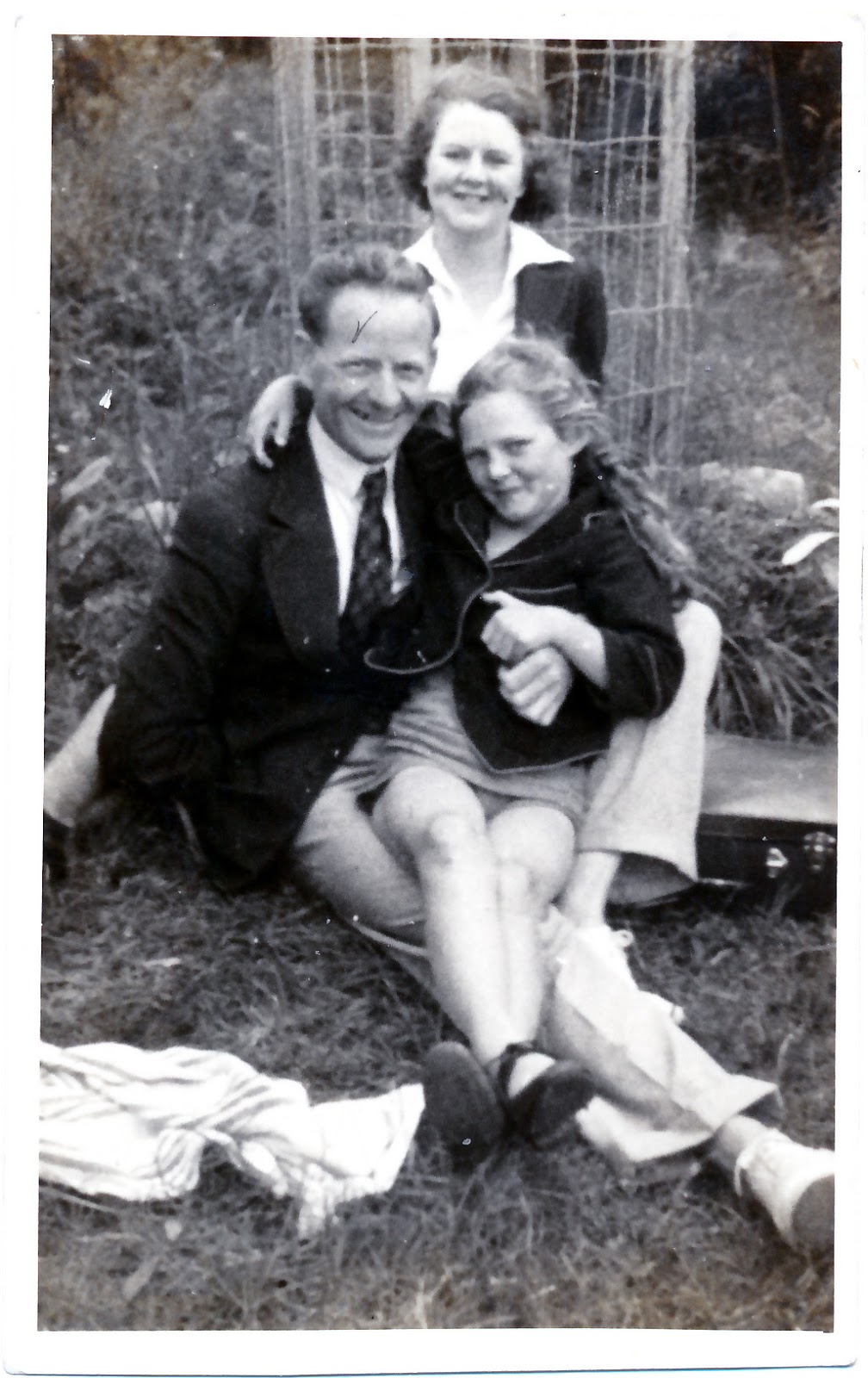
Bert, Viv & Bette 1935
How many of you knew that Sydney was bombed during World War 2?  I certainly don’t remember learning this at school in the 1960s.  However, my sister in law, Bette Mason (nee Moxon) certainly remembers it, because she was a teenager at the time.
I recently interviewed Bette, now aged 88 and living in a retirement village in Kincumber on the Central Coast of NSW about her life as a young girl and as a teenager.  Having been born in December 1927, she has vivid memories of life during the war:
“We were living in Bronte and they started bombing off the coast.  Mum didn’t like that so we moved to Hazelbrook. I went to Katoomba High School.  And when I finished there in Third Year, she wanted me to go back to Fort Street.  So I went back to Fort Street, but they were so far ahead of me, so advanced.  I didn’t like it so I left and found a variety of jobs, including  back door receptionist at the Minerva Theatre at Darlinghurst.[1]”[2]
The bombardment of Sydney, particularly the eastern suburbs, occurred in June 1942[3] and quickly stopped but the residents of Bondi and Bronte were not to know that.  Like many others, the Moxons sought safety in the Blue Mountains.
In 1936, for reasons unknown to Bette, her parents had taken her to London by ship, the steamer Moreton Bay[4].  I asked her how she felt about this:
“I was only eight at the time.  I didn’t question their decision to go.  We saw many countries, it was six weeks in those days.  It was very enjoyable.  I was always curious about new things.
 “It was hard getting used to my school at Sydenham.  I wasn’t very popular because this foreigner topped the class at the end of the year.  But also, they asked me to speak Australian, and I said I was. But they said I couldn’t be Australian because my mother’s not black.  So that was their knowledge of Australia.
 “We rented half a house in Sydenham.  It was very old and had a ballroom upstairs.  Mum and dad weren’t married at the time, they got married when we returned to Australia in 1938, before John was born.”[5]
I showed Bette three photos, one of two adults and a little girl, one of the same adults with two children, and another of the same man.
“Oh, this one here is me with Mum and Dad.  (See above). I was about seven or eight at the time, and yes, it was before we went to England.  And that one is Dad – Bert – he looks a bit younger there.  I always called him Dad, even though he was my adopted father. 
Bert Moxon 1902-1987
“My real father was Alf Prahl, but I didn’t see him from the time my mother left him until I was 45, when he contacted me.  I invited him up to Narrabri for a holiday, but I just thought of him as Alf, never as dad.  I felt embarrassed sometimes, when I unthinkingly talked about mum and dad this, mum and dad that.  But I couldn’t help it – I hadn’t seen him for 40 years, never a birthday card or anything.
“I think it was Mum’s doing really.  She told him she never wanted to see him again, and didn’t want any money from him.
Bert was a real father to me, and later he formally adopted me.”[6]
The third photo showed Bette, aged about 12 with her parents and brother John, born in 1938.
Viv, Bert, John and Bette Moxon 1940
“We were living at Lewisham when that was taken, because John was just a toddler then.  I loved having a baby brother, I’d been an only child up till then.  I used to pretend he was mine, pushing him everywhere in his stroller.  That was before we moved to Bronte during the war.”[7]

References

Gross, Rebecca The Minerva Theatre and Metro Kings Cross, in The Dictionary of Sydney, http://www.dictionaryofsydney.org/entry/the_minerva_theatre_and_metro_kings_cross ,
Mason, Bette, interview by Margaret Moxon, digital recording, Kincumber, 18 November 2016, in author’s possession.


[1] https://en.wikipedia.org/wiki/Minerva_Theatre,_Sydney  Minerva Theatre, accessed 5/12/16
[2] Bette Mason, interview by Margaret Moxon, digital recording, Kincumber, 18 November 2016, in author’s possession.
[3] Waverley Council. Shelling of Bondi, 1942. http://www.waverley.nsw.gov.au/__data/assets/pdf_file/0009/8667/Shelling_of_Bondi,_1942.pdf, accessed 5/12/16
[4] Ancestry.com. UK, Incoming Passenger List 1878-1960 for Herbert J. Moxon, accessed 5/12/16
[5] Bette Mason, interview by Margaret Moxon.
[6] Bette Mason, interview by Margaret Moxon.
[7] Bette Mason, interview by Margaret Moxon.

Sunday, April 17, 2016

James Moxham, Prince Regent 1820

Born in 1794, James Moxham was a son – probably the oldest – of Thomas and Sarah Moxham of Birmingham, baptised on 20th July, 1795.

In 1813, James joined the Foot Guard during the Napoleonic Wars.

This Moxham family established themselves as gunsmiths and later, maltsters and were upwardly mobile in Birmingham throughout the 19thcentury.

James’ brother, Thomas (born 1804) was originally a gun stockman, then a gunsmith, and at his death was described as a gun manufacturer, leaving an estate of “less than £12,000” at his death in 1878. His son Thomas, a maltster was also wealthy, leaving just under the same amount.

However, in February 1819, James Moxham was convicted at the Northampton Assizes of uttering forged notes and transported to New South Wales for fourteen years. He arrived on the Prince Regent in early 1820 and was sent to Parramatta for distribution.  At one stage he was located at Port Macquarie, but returned to Sydney well before obtaining his ticket of leave in 1831. He was given a certificate of Freedom in early 1833 when his sentence expired.

By 1826, James had requested and been approved to marry another convict Diana Hughes, also known as Mary Anne Rycroft, a dressmaker from London who was sentenced to transportation for life, arriving on the Midas in 1825.

By 1829, he was working for a Mr Jennings in Castlereagh Street, making shoes for children with misshapen feet, and gaining an excellent reputation for such work.  When he gained his certificate of freedom, he set up in his former calling as a gunsmith.


There is no NSW record of any children being born to James Moxham and his wife Diana/Mary Anne. It would appear that James died in 1848 in the Goulburn area, aged 55.

Saturday, January 2, 2016

More about Robert Moxon, convict, Adamant 1821

Robert Moxon, a butcher by trade, was baptised at St Mary’s, Nottingham on 4 April, 1803, the son of John and Phebe Mugson.  In every other record, his parents were named Moxon.  A John Moxon had married Phoebe Teel in South Lynn, Norfolk in 1794, the only recorded marriage of a John Moxon and a Phoebe.  A son John was born to the couple in 1796 and a daughter Elizabeth in 1805.  Sadly Elizabeth died the same year.

In 1818, his older brother John was convicted of larceny and sentenced to seven years transportation.  He arrived in Port Jackson on the Lord Sidmouth in March 1819 and was assigned to Captain Piper, a naval officer after whom the now affluent Sydney suburb of Point Piper is named. 


Here is more about Captain John Piper. 

John appears to have been highly regarded by his master, who found him “an honest, sober, industrious character, having faithfully served his master” (note 1), and recommended for a ticket of leave in 1823. Being a seaman, he became a ferryman on Sydney harbour and married a daughter of the well-known ferryman William Blue. (See Moxons Down Under Newsletter - May 2013)

The year after John’s conviction in 1818, younger brother Robert came to the attention of the law in Nottingham.  After a sentence of 12 months in October 1819, followed by an acquittal for a second offence, he was again convicted on 11th January 1821 of stealing from a shop (where he worked maybe?) and sentenced to seven years transportation.  He was sent to the convict hulk Justitia moored at Greenwich and on 26th March 1821 sailed for Port Jackson on the Adamant.
Adamant 1821


His behaviour suggests he might have been looking for a sentence of transportation after a positive experience by his brother, but then again maybe he just couldn’t help himself.

Robert was noted in the 1822 muster as also working for Captain Piper, but maybe the latter was disappointed in his work and character. 

By 1825, Robert was re-assigned to a landholder at Bathurst, a Mr Hawkins.  The very same year, he used his brother John’s Certificate of Freedom, and absconded.  Quickly caught, he was subjected to 50 lashes, and returned to his master at Bathurst.  Imagine his scars: by the fourth lash of a leather cat o’ nine tails, his skin would be broken, and by 50 lashes, his backbone would have been exposed.  The punishments were inflicted by other convicts, sometimes the convict’s fellow workers, in order to break loyalties.

Robert would have been expected to go back to work immediately, and his back may not have been washed until the following day. (note 2)

This event did not seem to have extended his sentence, because by 28th January 1828, he too had gained his certificate of freedom.  However Robert seemed not to be able to avoid temptation.  In 1830 he was tried for stealing beef and acquitted, but in 1833, he was gaoled for larceny.

It is assumed that John Moxon died before 1834 because Susannah Moxon married George Lavender in 1834.  No death record can be found.

Robert too, fades into oblivion.  Nothing further is heard of him in either Australia or England.

Notes:
1. Ancestry.co.uk  New South Wales Colonial Secretary’s papers, 1788-1856. Downloaded 20/11/15
2. http://www.convictcreations.com/history/punishments.html. Downloaded 18/11/15


Wednesday, January 16, 2013

1875 Melbourne arrival of John Walter and Sarah Ann Moxon

Scott Moxon Hults, a Moxon Society member who lives in Alabama, USA has discovered that one of his ancestor's brothers migrated to Australia.  He was John Walter Moxon, born 1850 in London, one of 11 children of George and Louisa Scott Moxon.  He married Sarah Ann Pearson in Southwark, Surrey in 1872.

John W. and Sarah Moxon arrived in Melbourne on the Lincolnshire from Gravesend on 9th September 1875.

John Walter was the brother of Scott's great grandfather, Arthur Moxon, born in Lambeth, London in 1860 and died in New Haven, CT in 1909.

So here is another Moxon family spread around the world.  Scott and his wife Vivian have been working on the tree MX48 for the Society.

Friday, December 21, 2012

Convict Thomas Moxon IS related!

We've just discovered, thanks to a Moxon Society member in the UK, that Thomas Moxon, the first Moxon convict to arrive in Australia is connected to the Joshua Middleton Moxon family.  Thomas was Joshua's great uncle.  He'd probably never heard of Thomas since it would have been a scandal to have a convict in the family.  Joshua's grandfather was Joshua Moxon, born 1751, baptised in Silkstone, and Thomas was his younger brother born 1759.  They were two of the many sons of John Moxon or Moakson of Silkstone born 1717.